
STAY CONNECTED
Signup for our blog to receive tips and knowledge on industrial wash and wash water treatment best practices.
Work with Us
Don’t settle for less than a solution from a partner who takes complete responsibility from start to finish. We make it easy to keep things clean and compliance effortless. Contact us today to discuss your wash water treatment and industrial wash needs.
01/21/2026
Win the Start of the Year.
Why Now Is the Best Time to Inspect, Service, or Upgrade Your Industrial Pressure Washers
From tank farms to refineries, heavy equipment cleaning is directly tied to inspection readiness, environmental compliance, and safe operations. When pressure washers go down, everything else slows too: inspections stall, compliance risks rise, and crews are forced to improvise with tools that weren’t designed for the job.
Now is when winners get ahead of those problems.
At Evans Equipment & Environmental, we see the same pattern every year across Gulf Coast tank farms and terminals: the operations that inspect early stay operational all year, while the rest spend spring reacting to avoidable failures. After year-end shutdowns, heavy Q4 production, and cold-weather exposure, industrial pressure washers are most vulnerable to hidden wear. The operations that start the year by inspecting, servicing, or upgrading their industrial power cleaning equipment are better positioned to control their risk of downtime.
Why Pressure Washer Failures Trace Back to Skipped Maintenance (Usually)
In tank farm cleaning operations, a failed pressure washer can delay API inspections, secondary containment cleaning, or scheduled maintenance windows. Suddenly, a small equipment issue turns into a major compliance headache. But most pressure washer failures don’t come from catastrophic misuse. They come from small issues left unaddressed, like:
- Worn seals that harden after cold exposure
- Pump oil breakdown after extended run times
- Clogged filters from high-solids washdown jobs
- Thermal relief valves compromised by freezing temps
These are the most common failure points our Evans service technicians uncover during January inspections, especially in Louisiana and Texas facilities following heavy Q4 production and winter exposure.
Evans works with industrial facilities to use Q1 as a planning window where we can evaluate equipment condition, upcoming inspection schedules, and cleaning demands before peak season pressure eliminates flexibility.
What to Inspect After Year-End Shutdowns or Heavy Equipment Use
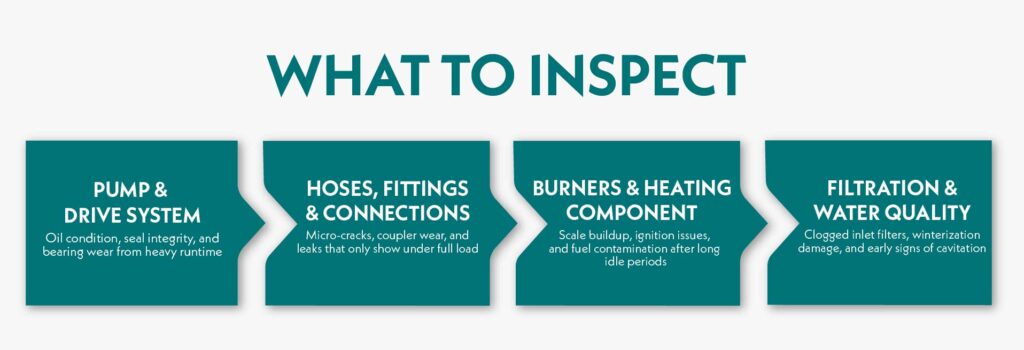
During Evans industrial pressure washer inspections, our technicians focus on the systems most likely to fail under peak demand. Key inspection points for industrial pressure washers include:
Pump & Drive System
- Oil condition and contamination
- Seal integrity and early leakage
- Bearing wear from extended runtime
Hoses, Fittings & Connections
- Micro-cracks caused by temperature swings
- Coupler wear and pressure loss
- Leaks that only show under full load
Burners & Heating Components (Hot Water Units)
- Scale buildup affecting efficiency
- Ignition issues after long idle periods
- Fuel system contamination
Filtration & Water Quality Components
- Clogged inlet filters from industrial power cleaning jobs
- Damage from poor winterization
- Early signs of cavitation
These inspection points form the foundation of Evans’ preventative service programs for tank farms, refineries, industrial terminals, and more. These issues don’t always shut equipment down immediately, but when peak season begins, they can compound quickly, resulting in unnecessarily expensive repairs or replacements.
Rent vs. Repair vs. Replace: How to Know Which One Makes Sense
Q1 is a natural time to plan for upcoming projects and make strategic decisions about equipment improvements. But how do you know when it’s best to rent heavy equipment or when it’s better to repair and replace?
For example, tank farms often require higher flow rates, hot water capability, and ruggedized systems that standard industrial washers can’t sustain long-term.
When You Should Repair:
- The unit has predictable wear issues
- Parts availability is reliable
- Downtime risk is minimal
- The machine still meets flow and pressure demands
Evans technicians evaluate repair decisions based on total downtime risk, which helps facilities avoid sinking money into equipment that can’t meet modern cleaning demands.
When You Should Rent:
- You’re facing short-term demand spikes
- Your unit is down but repairs won’t be immediate
- You need higher GPM or heat capacity for specific jobs
- Capital budgets are locked but work can’t wait
At Evans, we maintain a rental fleet of industrial-grade pressure washers designed for industries like tank farm cleaning, offering higher GPM, hot water capability, and rapid deployment when inspections or outages can’t wait.
When You Should Replace:
- Repairs are frequent and compounding
- Performance no longer meets modern cleaning standards
- Downtime costs exceed ownership costs
- You’re pushing equipment beyond its original design
When replacement is the right move, our Evans technicians can help facilities select pressure washing systems engineered for their actual flow, heat, and duty-cycle requirements. No guesswork. And your equipment achieves full utilization.
How Scheduled Service Programs Reduce Emergency Downtime
Emergency breakdowns are expensive, not just in repair costs, but in lost productivity, safety exposure, and compliance risk.
Facilities that rely on scheduled service programs see fewer surprises because:
- Wear items are replaced before failure
- Inspections catch early-stage issues
- Maintenance aligns with operational cycles
- Equipment life is extended predictably
For clients like industrial power cleaning operations, scheduled service turns pressure washers into reliable assets instead of recurring liabilities. Evans’ scheduled service programs are designed around how these types of facilities actually operate. We align maintenance with shutdowns, inspections, and seasonal demand instead of reacting to failures after they happen.
And when something does go wrong? You already have a service partner who knows your equipment and your standards.
Start the Year Winning
The operations that start the year reacting to breakdowns spend the rest of it catching up.
But the ones that inspect, service, or upgrade in January stay ahead of them.
If your facility depends on industrial pressure washers, tank farm cleaning systems, or high-performance industrial power cleaning equipment, now is the time to act before demand, heat, and inspections stack the odds against you.
Talk to Evans about industrial pressure washer rentals.
Winners don’t wait for equipment to fail. They plan for it.
FAQs: Pressure Washing on a Tank Farm
What pressure washer specs are best for tank farm cleaning?
Most tank farms require high-flow systems (8 – 12+ GPM) with sufficient pressure, hot water capability, and industrial-duty pumps designed for continuous use. Flow rate matters as much as PSI when removing heavy hydrocarbons, sludge, and solids from containment areas, tank bases, and transfer zones.
How often should tank farm pressure washers be serviced?
For Gulf Coast tank farms and terminals, Evans recommends quarterly inspections, with preventative service aligned to shutdown schedules, inspection cycles, and peak cleaning seasons. High-use or hot-water units may require more frequent service to prevent pump, burner, and seal failures.
Should tank farms rent or own industrial pressure washers?
It depends on utilization and risk tolerance. Ownership makes sense for consistent, year-round cleaning needs. Rentals are often the smarter move for Louisiana and Texas terminals facing seasonal demand spikes. But many facilities use a hybrid approach, owning core equipment while renting to handle peak demand without overextending your assets.
What causes the most common pressure washer failures in tank farms?
Cold-weather exposure, skipped maintenance after heavy use, clogged filtration from high-solids washdowns, and delayed seal or oil changes are the most frequent culprits that we see on our service runs.