Solutions
Locations
STAY CONNECTED
Signup for our blog to receive tips and knowledge on industrial wash and wash water treatment best practices.
WORK WITH US
Don’t settle for less than a solution from a partner who takes complete responsibility from start to finish. We make it easy to keep things clean and compliance effortless. Contact us today to discuss your wash water recycling and industrial wash needs.
At Evans Equipment and Environmental, we customize every wash bay to maximize efficiency, minimize liability, and improve water reuse time. Let’s follow the life cycle of water inside an Evans washbay, starting with pre-treatment. As you clean equipment, water runs into the first section of the center trench drain. In addition to functioning as the primary point of water collection, it also allows the heavier suspended solids to settle while water rises and spills over a baffle wall into a smaller plated compartment. Here, any suspended solids that make it past the first compartment will continue to settle. As water rises, it will then be transferred to an above ground oil water separator where free flowing oil is directed into a dedicated collection container for easy disposal.
Next, water flows into a three compartment oil water separator where remaining suspended solids continue to settle to the bottom. Oil rises to the surface and water flows from the middle zone, leaving large contaminants behind. In the final compartment, a float activates an additional pump to transfer water into the water treatment system.
Inside the Evans biological water treatment system, suspended solids will continue to settle as microbes consume oil and hydrocarbons, breaking down any remaining contaminants. Oxygen is continually introduced into the system through diffusers to keep the water aerobic and new microbes are injected as needed to maintain a healthy colony. The last compartment will hold the treated water waiting to be transferred back to the pressure washer.
All compartments are equipped with drain lines which will be tied together in a common drain line that will be run back to the original trench drain. This will give the user the ability to periodically dump any settled solids in all compartments and send them back to the trench drain where it is easier to remove them. Also, the drain line back to the trench drain will be set up to trickle a small amount of water when the user is not doing any washing in order to ensure that the water in the system continues to circulate. Minimal circulation of the system will ensure extended life of the microbes and maintain system efficiency.
When an operator pulls the trigger on the pressure washer, the bladder tank signals the pump to turn on, sending treated water from the processed water compartment through a final cartridge filter back to the pressure washer. The result is a closed loop system designed to recycle water for months at a time and extend time between cleanouts.
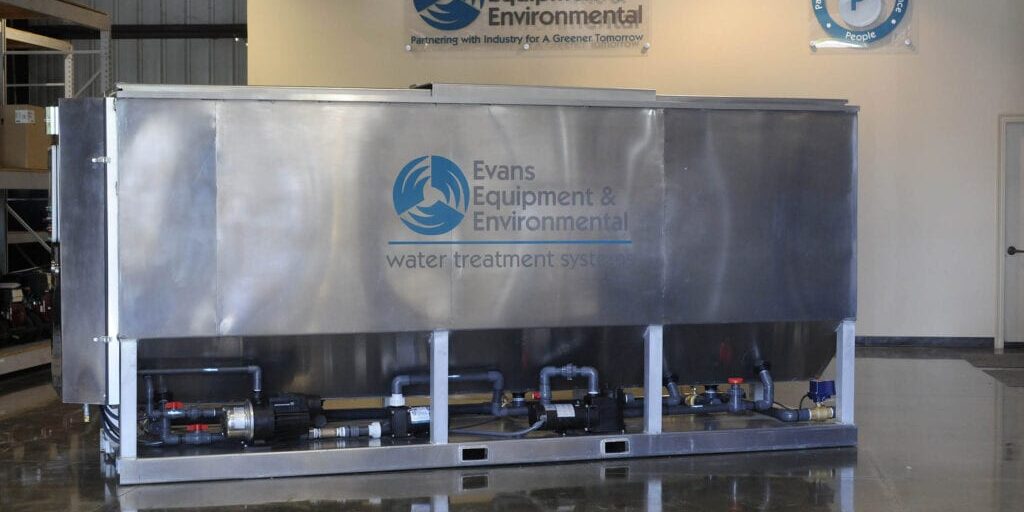
The Evans Bio System (EBS) is the premier solution for industrial wash water treatment in a closed loop system. Using a proven bioremediation process, the EBS rapidly breaks down organic contaminants such as oil, grease, diesel, drilling mud. The microbes then convert these into water and carbon dioxide, resulting in reusable water for your wash bay or pressure washer, or cleaner, compliant discharge.
Engineered in marine-grade aluminum, the EBS delivers durability, ease of installation, and reliable performance in the toughest industrial environments.
How It Works
Wastewater treatment systems are highly specific – a unit designed for suspended solids may not efficiently remove emulsified oils or heavy metals, and vice versa.
The Evans Bio System applies a biological treatment process that uses naturally occurring microbes to break down light ot medium contamination, including:
- Grease
- Oils
- Drilling mud
- Hydrocarbons
- Organic matter
This process effectively and rapidly degrades organic contaminants, producing clean water (100-50 microns) suitable for reuse or compliant discharge.
Treatment Process:
- Collection & Containment: Contaminated wash water enters the EBS unit.
- Biological Breakdown: Microbes digest oils, greases, and hydrocarbons, then convert them into water and CO₂.
- Separation & Polishing: Remaining solids settle out, leaving clear, treated water ready for reuse or compliant discharge.
Specifications & Key Features
- Marine-grade aluminum construction for corrosion resistance and longevity
- Easy installation — self-contained and skid-mounted with forklift pockets
- Rapid biodegradation of oil, grease, diesel, and hydrocarbons
- Compact footprint for mobile or fixed-site use
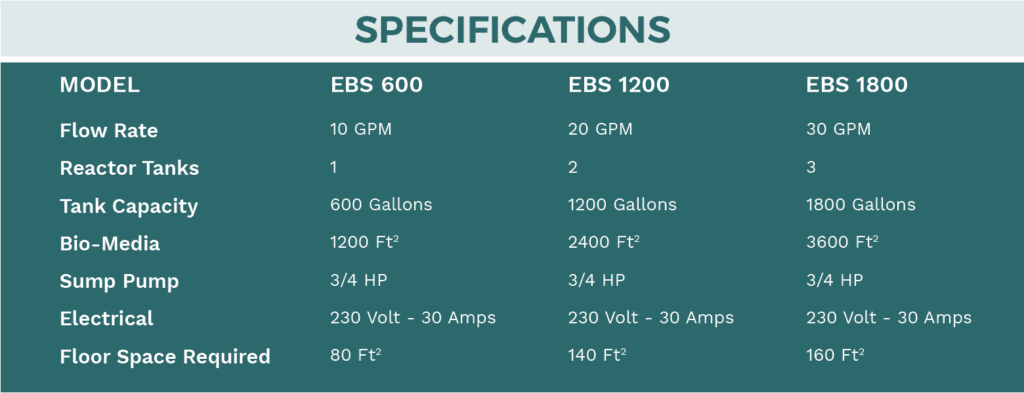
- Available in multiple capacities based on flow rate and site requirements.
Wherever there’s heavy equipment and oily wash water, the EBS turns your environmental challenge into a closed-loop solution.
Ideal For: Demanding operations that generate oily, hydrocarbon-heavy wash water.
- Oil & Gas
- Military
- Government
- Power Generation
- Heavy Equipment
- Construction
- Transportation
- Municipalities
Compatibility & Systems Integration
For sites facing both organic and suspended solid contamination, the EBS can be paired with an Evans Mechanical Filtration System (EMF) or Oil Water Separator for a customized wash water treatment solution.
- Oil Separator: removes heavy oils and solids before biological treatment
- Evans Mechanical Filtration System (EMF): filters out clays, silts, and flocs
- Evaporator or Recycle System: manage water reuse or disposal efficiently
Together, these systems create a closed-loop wash bay setup that minimizes environmental impact and ensures regulatory compliance.
1. What contaminants can the Evans Bio System remove?
The EBS is designed to break down organic contaminants such as oil, grease, diesel, drilling mud, and hydrocarbons.
2. How clean is the treated water?
The EBS can reduce contamination down to approximately 100–50 microns. For finer filtration, pair with an Evans Mechanical Filtration System.
3. Is microbial activity tracked in the EBS?
The best indicator of microbial activity is your water quality. When the system is functioning properly, you’ll see clear, consistent results. If water quality starts to decline, that’s a sign the microbes have gone anaerobic (meaning they’ve stopped working and gone dormant). To prevent that, the EBS is designed to keep microbes healthy and active by continuously circulating and oxygenating the water. The flow from the sump maintains just enough movement to keep the microbes thriving — because they don’t like to sit still.
4. Is this system easy to install?
Absolutely. Each unit is skid-mounted and self-contained, making setup fast and straightforward.
5. Does it require ongoing maintenance?
Like all wash water systems and equipment, the EBS benefits from scheduled maintenance to monitor biological activity and keep the system running efficiently. Evans offers scheduled maintenance programs nationwide.
6. Does it meet EPA discharge standards?
Yes. The EBS helps your facility stay compliant with EPA and local discharge regulations by treating wastewater before discharge or reuse.
7. Is this system customizable?
Yes, it can be combined with other Evans wash water recycling systems to support wastewater solids management.
8. What maintenance is required?
Regular maintenance includes removing solids, checking and cleaning filters, and ensuring that the chemical coagulate and microbe levels are satisfactory. Due to evaporation, the system may require water to be added on occasion. Ideally, the water should be hauled off approximately once a year. Schedule Evans Maintenance to enroll in expert technician protection.