
STAY CONNECTED
Signup for our blog to receive tips and knowledge on industrial wash and wash water treatment best practices.
Work with Us
Don’t settle for less than a solution from a partner who takes complete responsibility from start to finish. We make it easy to keep things clean and compliance effortless. Contact us today to discuss your wash water treatment and industrial wash needs.
04/15/2026
Building a Custom Wash Bay with Evans
You’re running heavy equipment on a high-risk site, washing on a schedule that doesn’t slow down, inside a regulatory environment that doesn’t leave any room for mistakes. Getting a permanent wash bay is no longer optional, but the wrong one will cost you more than no wash bay at all.
You don’t need a slab poured into whatever footprint you’ve got with an off-the-shelf treatment system bolted on. You need a system that was designed for what you’re actually doing. One custom solution that takes it all into account: your equipment size, your daily wash volume, your contaminant profile, your site conditions, and your regulatory environment.
You need a custom wash bay. Here’s how Evans does it.
The Decision Most Builders Skip
Determining Flow and Wash Bay Pit Type
Before we talk square footage, we need to address how water and solids are going to move through your system. Get this wrong and every other decision downstream is compromised.
We build around two pit configurations, depending on what you’re cleaning and how your equipment moves. We’ll tell you which one fits your operation, not which one is easiest for us to fabricate and pour.
If you’re running stationary vehicles at light to medium duty with high water volume, a Center Trench gives you even drainage from all sides and handles the flow efficiently.
If you’re dealing with large, heavy equipment and high solids in each load, a Slope Drive-In Pit is your answer. Gravity does the brunt of the work, pulling debris directly into a recessed collection point where it belongs before undergoing water treatment.
Each of those pairs with either a drive-in/back-out or drive-through layout. That gives you four distinct base designs before we’ve added a single site-specific variable. Your traffic patterns, your turn radius, and your site geometry all factor in to shape the final configuration.
We’ve seen what happens when those details get glossed over – you end up with a wash bay that works on paper and creates bottlenecks in practice.
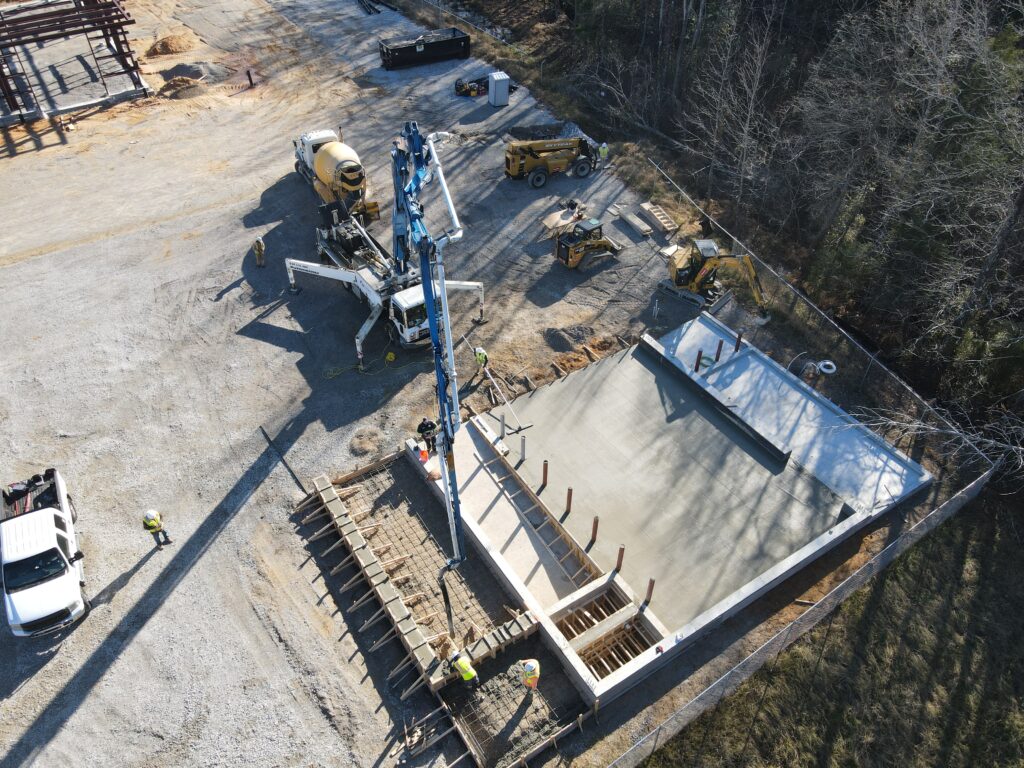
Concrete Engineered For Your Environment
Most concrete failures in wash bays aren’t a mystery. Oils, bacteria, constant moisture, and heavy rolling loads will destroy a standard mix over time. Predictably. The fix isn’t paying double to pour more concrete. It’s to start with a formulation that was designed for what you’re putting it through.
Evans embeds microbial additives directly into our concrete blend to fight bacterial and oil degradation from the inside out. From there, the spec depends on your specific conditions: like standard rebar for heavy vehicle traffic or fiberglass rebar where corrosion is a factor.
Concrete issues are one of the first things that show up in long-term repair costs. We plan for the problems, so you’re not surprised later on.
The Science of Water Treatment
The pit and the concrete are the bulk of the built structure, but the biosystem is what actually makes everything work.
Evans’ closed-loop water treatment process removes contaminants in stages:
- gravity settling pulls out heavy solids first,
- a three-compartment oil-water separator handles free oil and finer particulates,
- and aerobic biological reactors break down remaining grease and hydrocarbons at a molecular level.
Treated water recirculates back to your pressure washer, and the loop closes.
In a properly maintained system, you can reuse that water for eight to twelve months between cleanouts. But that’s only achievable when the biosystem is sized correctly for your wash volume and contaminant profile. Undersize it for your load, and you’ll be calling us for service more often than you should be. Oversize it, and you’ve spent capital that didn’t need to leave your account.
There’s no shortcut here. Knowing the right specs and standing behind it is what a custom wash bay means at Evans.
Solving Problems on Site Before They Happen
Once your core design is set, your site-specific conditions drive the rest.
Do you have overspray risk to surrounding equipment? Splash walls.
Exposure to weather that shuts you down seasonally? A covered structure puts you back into year-round operation.
Need to address safety concerns and compliance? Relieve congested traffic flow? Engineer aprons, handrails, and bollards into your custom wash bay design.
If you need fuel, oil, or air integration in or around the wash bay, we can handle that too.
These elements exemplify the difference between a site consultation with someone who’s seen three hundred wash bays and one who’s seen three. We know what your site is going to need before you run into it yourself.
One Team. Zero Fingerpointing.
You already know how this goes. One contractor for the equipment. Another for the concrete. Someone else handles the treatment system. A separate contact for permitting. And when something goes wrong or doesn’t connect the way it should or never arrives, everyone’s suddenly unreachable or passing the buck to the guy next to them.
Nobody owns the interfaces between them, and that’s where failures happen.
When you work with Evans, that problem goes away. One phone number. One team handling everything from site consultation to fabrication to plumbing to total system installation. And, after startup, you don’t have to worry about operator training and scheduled maintenance because we take care of that too.
That means when something needs to be addressed, you’re not spending your time reconstructing a vendor chain to figure out whose problem it is. It’s ours. That’s the arrangement from day one.
Ready to Move from Interest to Investment?
Evans designs custom wash bays for heavy equipment operations nationwide. Start with a site consultation. We’ll tell you exactly what you need, what you don’t, and why.
From design approval to operational, most builds run 30 to 60 days. That timeline holds because Evans manages the entire build in-house.
If you’re washing heavy equipment on a regular schedule with large contaminant loads, then a properly engineered system pays for itself in water savings, decreased liability, and regulatory compliance. We’ll tell you in the consultation how the numbers work for your volume.
It means your wash water is treated and recirculated rather than discharged. In a correctly sized system, that loop can stay clean for as many as 8 – 12 months between major cleanouts, which keeps you out of trouble with discharge regulations.
Depends on your climate, your wash frequency, and what’s surrounding the bay. It’s one of the first things we evaluate on a site visit. Some operations need it. Some don’t.
Evans offers monthly, bi-monthly, and quarterly maintenance programs staffed by Evans-trained technicians. Your crew handles daily maintenance and solids removal, but we handle the rest on a schedule that fits your operation.
Both. If you have a system that’s underperforming or was never sized correctly for your load, a site evaluation will tell us whether it can be brought up to spec or needs to be redesigned.
That’s exactly what the site consultation is for. Unusual constraints are the rule, not the exception. We’ve handled them before, and we’ll document every decision so you understand what was built and why.