
STAY CONNECTED
Signup for our blog to receive tips and knowledge on industrial wash and wash water treatment best practices.
Work with Us
Don’t settle for less than a solution from a partner who takes complete responsibility from start to finish. We make it easy to keep things clean and compliance effortless. Contact us today to discuss your wash water treatment and industrial wash needs.

05/22/2026
When the EPA Notices, You’re Already 90 Days Behind
Most facility managers don’t wake up after dreaming about water reclamation systems. Nobody is browsing wash bay solutions the way homeowners browse kitchen remodels. The decision to build a permanent, closed-loop wash bay typically happens out of necessity for compliance or job site efficacy.
Building a permanent, closed-loop wash bay with Evans takes 60 to 90 days from first call to operational. The question isn’t whether you need this. It’s how much longer you’re willing to operate with five-figure daily violation potential.
Here’s what your regulatory exposure looks like in real numbers, and what it takes to fix it with Evans Equipment & Environmental.
Common Triggers That Force Wash Bay Compliance: EPA Violations, OSHA Citations, and Discharge Incidents
While many make proactive strategic investments, some managers drag their feet shopping around on price for materials and vendors. Then, something happens that forces their hand, and they’re deep in downtime waiting on a build that won’t start for another 7 months. Every day without compliant facilities, you’re one inspection away from a stop-work order, one runoff event away from Natural Resource Damage assessments, or one contract review away from disqualification. The math only gets worse the longer you wait.
- EPA Clean Water Act Violations for Vehicle Washing Without NPDES Permits
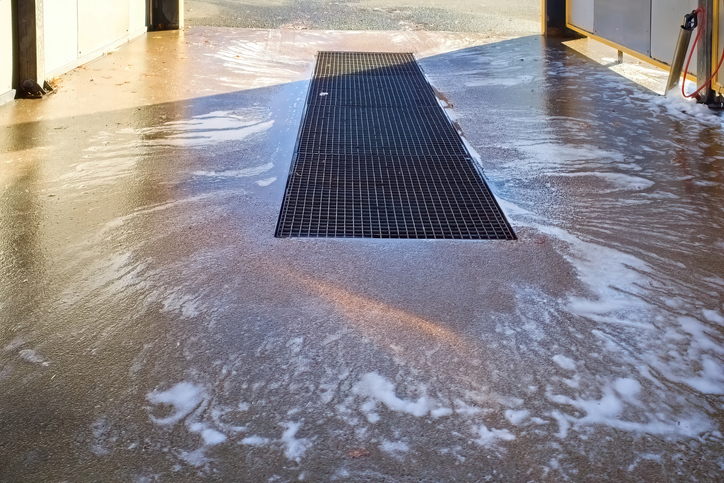
You’re washing a mixer truck in your yard when a white SUV pulls up. It’s an inspector from the regional EPA office. She takes photos of the wash water running across the lot toward the storm drain, asks if you have an NPDES permit, and says a written notice will arrive within the week.
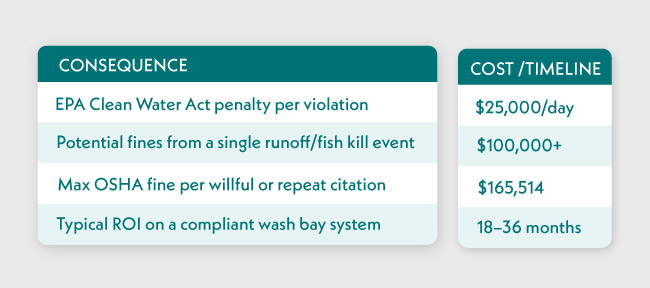
A Notice of Violation shows up for unpermitted stormwater discharge under the Clean Water Act. Your facility is washing vehicles without an NPDES permit or proper containment. Finally, you’re violating 40 CFR 122.26. Now, you have 90 to 120 days to achieve compliance or face penalties starting at $25,000 per day per violation under Section 309(d).
- Stormwater Discharge Violations: Natural Resource Damage Assessments and Fines
A neighbor calls the county about “soapy water with oil” coming out of the storm drain into the creek behind your facility. You realize it’s from yesterday’s equipment wash. By the time you get the call, the state environmental agency has already been notified and opened a case file. The creek feeds into a public water supply watershed.
If petroleum products, heavy metals, or phosphates are involved, you’re looking at Natural Resource Damage assessments on top of Clean Water Act penalties. A single fish kill event can trigger over $100,000 in fines, plus remediation costs.
- MS4 Permit Violations and Municipal Stormwater Enforcement Actions
The city sends a letter to every business on your industrial park: they’re under an EPA consent decree and conducting mandatory stormwater compliance inspections within 60 days. When the inspector arrives, you’re washing a truck in the parking lot. He writes you up on the spot. That’s $2,500 per day citation until you can demonstrate compliance with the municipal stormwater ordinance.
The EPA has been putting pressure on municipalities to crack down on stormwater violations, often through consent decrees that force enforcement. When that happens, they start looking for easy targets. A facility washing vehicles in the parking lot is about as easy as it gets. Local ordinances typically allow them to fine you $1,000 to $5,000 per day, and when they’re under federal pressure to show enforcement activity, they absolutely will.
- OSHA Wash Bay Violations: Walking Surface and Chemical Exposure Penalties
One of your operators slips on the wet concrete near the wash area and goes to the ER with a sprained wrist. Three days later, OSHA shows up for an inspection. Apparently the hospital filed a report. The inspector finds standing water, no proper drainage, and inadequate chemical storage signage.
You get hit for OSHA 1910.22 (walking-working surfaces) and 1910.141 (sanitation) violations. Fines run $16,550 per violation for serious citations. If they classify it as willful or repeated, you’re looking at over $165,514 per citation. More importantly, you’re exposing workers to injury liability.
- Vehicle Corrosion Costs from Improper Wash Bay Practices
Your fleet manager walks into your office with a spreadsheet and says three of your seven-year-old trucks need frame replacement, which is two years earlier than projected. The undercarriage corrosion is severe enough that they’re not safe to operate. He’s traced it back to inconsistent washing practices that left road salt sitting on the frames all winter.
Road salt, calcium chloride, and magnesium chloride cut vehicle frame life significantly. Paint oxidation, undercarriage corrosion, and hydraulic seal deterioration will cost you tens of thousands per vehicle in accelerated replacement cycles.
Most facilities hit two or three of these before they realize they have to make the call.
Cost of Non-Compliance: Daily Fines, Fleet Damage, and Lost Contract Opportunities
The biggest cost is compounding liability. Between the water bills and the fines, the violations on top of that can cripple your operation. Every day you operate without compliant wash facilities, you’re building a liability stack. The longer you wait, the more risk accumulates, often in unpredictable and catastrophic ways.
But, consider also the opportunity cost for your business. How many bids have you skipped because you couldn’t check the compliance box? Think about the contracts you’ve renewed at lower margins because you couldn’t demonstrate environmental leadership. And how much fleet value have you written off simply because aggressive washing wasn’t an option?
Delay has a dollar amount. It’s just harder to see because it’s distributed across missed opportunities, elevated risk, and accelerated depreciation. But your competitors who built their wash bays two years ago? They can see it clearly paying off now in their P&L.
Closed-Loop Wash Bay Installation Process: From Site Assessment to Operational System With Evans
- Wash Bay Sizing and Permit Requirements Assessment
You describe your operation: fleet size, vehicle types, wash frequency, site constraints. Then, we identify which permits you need: NPDES Industrial Stormwater Permit, local pretreatment permit if you’re discharging to sewer, or Air Quality permits if you’re using VOC-containing cleaning agents.
- On-Site Evaluation for Containment and Water Reclamation Systems
We visit your facility with the regulatory checklist. Measure your site for containment requirements. Check existing utilities against what’s needed for a closed-loop reclaim system. Evaluate soil conditions if you need infiltration basins.
- Construction Timeline: 30-60 Days to Compliant Wash Bay Operations
That’s right – 30 to 60 days from breaking ground to operational for most operations. That includes:
- Concrete containment pad with perimeter trenching, oil-water separator, and Evans biosystem
- Water reclamation system sized to your wash volume
- Filtration to meet your discharge limits
- Compliance documentation and materials for permit maintenance
- Training your staff on system operation and spill response
If You’re Thinking About It, You’re Already Exposed
The question isn’t whether you need compliant wash facilities. You know you do. It’s how much longer you want to operate with $25,000-per-day violation potential hanging over you.
If you’re operating without compliant facilities, call Evans.
Frequently Asked Questions
Most vehicle wash operations need an NPDES Industrial Stormwater Permit (or state equivalent) if you discharge to surface waters, or a local pretreatment permit if discharging to sanitary sewer. We handle permit applications and know the specific requirements for your state’s environmental agency.
Yes. Most violation notices give you 90 to 120 days to achieve compliance. We can complete construction in 30 to 60 days once permits are in hand.
Your permit requires regular maintenance, monitoring, and recordkeeping. NPDES permits typically require monthly visual inspections, quarterly sampling if you’re discharging, and annual reporting. If your system falls out of compliance because of poor maintenance, you’re still liable for permit violations. We provide O&M manuals, training, and maintenance contracts to keep you compliant. The system doesn’t make you compliant – operating it correctly does.
Mobile services work for occasional cleaning, but if you’re washing fleet vehicles regularly, especially heavy equipment with road salt, concrete residue, or petroleum, then you need consistent, compliant infrastructure. Mobile services also don’t eliminate your liability if they discharge improperly on your property. And if you’re under a violation notice, “we hire someone else to wash” won’t satisfy the EPA’s compliance requirements. You’re still the responsible party for discharges from your facility.
Most operators see ROI in 18 to 36 months when you factor in avoided fines, extended equipment life, and contract opportunities you couldn’t bid before. But here’s the real math: one EPA violation notice puts you at $25,000/day penalty exposure. The question isn’t payback, it’s how much liability you’re willing to carry.