
STAY CONNECTED
Signup for our blog to receive tips and knowledge on industrial wash and wash water treatment best practices.
Work with Us
Don’t settle for less than a solution from a partner who takes complete responsibility from start to finish. We make it easy to keep things clean and compliance effortless. Contact us today to discuss your wash water treatment and industrial wash needs.
09/17/2026
How a Portable Wash Rack Installation Works
Inside the Gulf Coast fall turnaround season, refineries and petrochemical facilities across Louisiana and Texas pull major process units offline in sequence, after summer driving demand subsides and before winter heating demand returns. Wash containment either arrives before the outage opens, or the facility carries the cost of its absence for the rest of the turnaround.
That timeline is part of why Evans Equipment formed a dedicated division: Evans Industrial. EI provides industrial cleaning equipment and portable wash racks, installed and decommissioned by Evans crews nationwide. Because Evans Industrial manufactures the wash racks, we shorten both the lead time on new units and the response window when a project moves.
What happens when one of those racks gets installed on a Gulf Coast turnaround site? Watch the new Evans Industrial animation to see every phase of the process.
What Is a Portable Wash Rack?
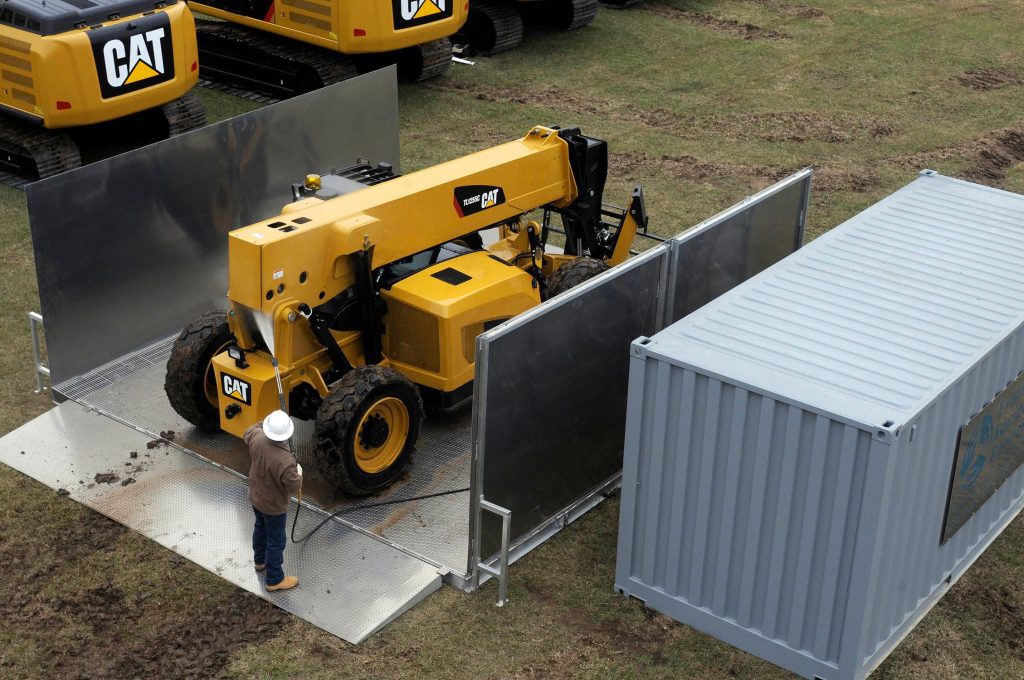
A portable wash rack is a modular, above-ground containment platform for industrial equipment washing. Evans Industrial builds them in steel sections, configured to your site footprint starting at 20 feet by 10 feet, with each section rated at 40 tons of load. The trough system runs through the deck. Nothing discharges to soil or reaches a storm drain in compliance with NPDES stormwater permitting requirements.
Equipment enters by crane or drives on across integrated ramps. From there, the same footprint handles shell-side cleaning, lance cleaning, decontamination, and high-pressure rinse work without leaving the containment envelope.
Where Can a Portable Wash Rack Be Installed?
Anywhere the ground is flat and load-bearing. Gravel, asphalt, and concrete all work. What’s critical is that the surface holds the weight and drains predictably once wash water begins flowing through the trough system. No excavation, permanent plumbing, or concrete pour is required.
That opens the door for sites where a fixed wash bay is impractical, including: remote job sites, leased laydown yards, contractor compounds, and refinery or petrochemical facilities during turnaround.
What Are the Installation Phases?
Installation runs on a compressed schedule. Against a turnaround clock, the sequence likely looks like this.
- Site Elevation and Drainage Survey
An Evans Industrial field team member or someone from your site surveys the ground where the wash area will be before the first section can leave on the trailer. Laser levels shoot elevations across the installation footprint. This confirms the surface sits level enough for the rack to seat flat and maps how wash water will move once the trough system is in service. Elevation data determines whether the site needs grading, and where runoff will pool if drainage patterns shift under load.
- Grading, If Required
When elevations show a slope beyond spec or soft spots that will settle under a loaded rack, the Evans crew handles the correction as part of the same mobilization. Your on-site team can also perform this work if preferred. That keeps the schedule intact and removes the coordination lag that comes from routing site prep through a separate contractor. Sites already within spec skip this phase entirely.
- Delivery and Section Placement
Sections travel on standard flatbed trailers, no oversized-load permits or wide-load escorts required. On site, the crew stages sections in the sequence that matches the operational layout. A long single-lane rack allows continuous wash-through of vehicles and rolling stock. A wider footprint better accommodates crane-set decontamination of heat exchanger bundles, reactor internals, or catalyst equipment.
- Assembly and Containment Integration
Sections lock together into a continuous containment surface. The trough system runs along the perimeter and interior of the rack, collecting wash water at every low point. Since there’s no buried plumbing, the containment loop closes above ground instead. Consequently, it installs faster today and, just as importantly, breaks down faster later, whenever the rack rotates to the next site.
- Load-In and First Wash Cycle
Equipment enters the rack by crane or across integrated ramps. First, every gallon of runoff flows into the trough system for capture and treatment. Then, depending on how the site is configured, that water is either recycled or sent to authorized disposal. The rack supports the full range of cleaning scopes Evans Industrial customers run daily:
- Shell-side cleaning on heat exchanger bundles and pressure vessels
- Lance cleaning of tubes and internals with high-pressure water
- Equipment decontamination for catalyst, hydrocarbon, and chemical residue
- General-purpose high-pressure rinse on rolling stock, vac trucks, and industrial machinery
Evans Industrial pairs the rack with its own industrial cleaning equipment fleet, rated up to 5,000 PSI at 250°F. Get one vendor with one rental agreement and one crew on site.
How Much Weight Does Each Rack Section Hold?
Each section carries a 40-ton load rating. That covers the equipment typical of refinery turnarounds and petrochemical maintenance. Cranes can place equipment on the rack without staging concerns about deck failure or point-load stress.
Should You Buy or Rent?
Both options are on the table. Purchase makes sense for operators who run continuous wash operations across the year and want the rack on standby between projects. Rental fits contractors who need coverage for a defined scope: a single turnaround, a shutdown event, a construction phase, or a fleet decontamination assignment.
The economics track utilization. Facilities with recurring wash cycles amortize the capital purchase against many projects. Contractors carry no ownership cost between jobs and get the same containment performance for the window they need it.
Part of the Evans Equipment Family
Here’s the breakdown: Evans Industrial is the industrial services division of Evans Equipment.
Evans Equipment handles water treatment, bio systems, and environmental services. Meanwhile, Evans Industrial specializes in packaging industrial cleaning equipment and portable wash rack solutions. Together, the two cover both sides of the job.
You Know the Job. We Know the Equipment.
Tell us the application. We’ll build the solution.
To scope a Portable Wash Rack for a specific turnaround window or ongoing operation, request a quote or call the Evans Industrial team at 225-351-1165.