
STAY CONNECTED
Signup for our blog to receive tips and knowledge on industrial wash and wash water treatment best practices.
Work with Us
Don’t settle for less than a solution from a partner who takes complete responsibility from start to finish. We make it easy to keep things clean and compliance effortless. Contact us today to discuss your wash water treatment and industrial wash needs.

04/23/2026
What Skipped Maintenance Actually Costs Your Wash Bay Operation
A custom wash bay is a significant capital investment. Most facilities treat the build as the finish line. But they don’t always answer the question: what happens after the concrete sets and the system starts running?
That’s when maintenance decisions, or lack thereof, start showing up in the operating budget.
Biological treatment systems, oil-water separators, pressure washers, and trench drains all have predictable failure patterns. It’s rare that they fail suddenly. They degrade incrementally, usually because a small issue went unaddressed long enough to become a big, expensive one. Facilities that run scheduled maintenance programs catch those issues early, adjust them or conduct small repairs as needed. Facilities that don’t end up calling for emergency service, expedited parts, and unplanned downtime, often at the worst possible time.
Here’s the most common failure points Evans technicians encounter across industrial wash bay operations, and what a structured maintenance program does to prevent each one.
The Most Common Preventable Problems Evans Technicians Find in the Field
These aren’t freak equipment failures or user error breakdowns. We’re talking about common issues that can be easily avoided with preemptive maintenance. Let’s get into some of the recurring problems that show up on service calls across tank farms, equipment dealerships, landfills, refineries, and fleet maintenance facilities nationwide.
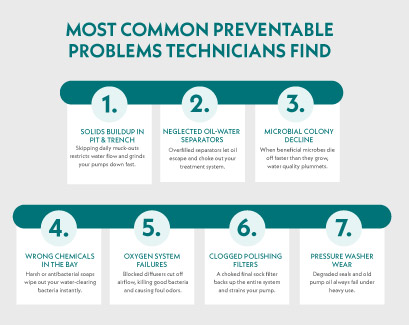
- Solids buildup in the trench and pit
When debris isn’t cleared out on a regular schedule, it reduces system capacity, slows water flow, and grinds your pumps down faster than normal. In biological treatment systems, too much solid buildup also starves the microbes that keep your water clean. And that shortens how long you can reuse it before a full cleanout. This is daily maintenance. Your team has to own it. Skipping even just a few days can create major problems fast.
- Neglecting the oil-water separator
Oil that sits too long in the separator doesn’t stay there, it moves forward into the biosystem, coating the media the microbes live on, which cuts off the oxygen they need to work. Once that happens, your treatment efficiency drops significantly, and it will take time to recover. Weekly visual checks and periodic flushing of accumulated solids through the return line keep this from becoming a bigger problem.
- Microbial colony decline
The microbes doing the work in your biosystem are living organisms. And they naturally die off over time. If the die-off rate exceeds the growth rate, due to chemical contamination, oxygen disruption, or irregular circulation, then water quality drops and your treatment performance degrades. That means you’ll have to call for cleanouts more frequently. Keeping the microbial colony healthy means monitoring it and occasionally introducing fresh cultures.
- Wrong chemicals in the wash bay
Harsh or antibacterial detergents kill the microbial colonies your biosystem depends on. It’s one of the most common causes of biological treatment failure, and one of the easiest to avoid. At Evans, we provide a list of approved detergents and operating protocols for exactly this reason. Using something outside those guidelines can set your system back significantly.
- Oxygen system failures
Your biosystem runs on aerobic bacteria – microbes that require continuous oxygen to function. When oxygen delivery gets interrupted, whether from a blocked diffuser, a pump issue, or a circulation problem, the wrong kind of bacteria take over. Treatment stops working, odors develop, and getting back to normal means re-establishing oxygen flow and potentially restarting the microbial culture. Catching oxygen system issues early is much easier than recovering from them.
- Clogged polishing filter
The final sock filter catches whatever made it through the earlier treatment stages before water cycles back to the pressure washer. A clogged filter backs up the whole system and adds strain to the pump. Addressing this is simple. Don’t skip it.
- Pressure washer wear
Seals degrade, pump oil breaks down, inlet filters clog, and burner components scale up. None of these fail overnight, but they can accumulate and surface at the worst time, usually under heavy use. Cold weather and long run times accelerate all of them. Regular inspection catches these before they become downtime.
Your system was designed to handle the work, but it has to be looked after. If you’re dealing with a maintenance gap, call us. (800) 377-5872
What Downtime Actually Costs
When a wash bay goes down, the repair bill is usually the least of it.
The backlog starts immediately.
Equipment doesn’t stop getting dirty because your wash bay is offline. In operations where washing is tied to inspection readiness or compliance requirements, a downed system doesn’t just create inconvenience. It creates a regulatory problem. In tank farm and refinery environments, a failed wash system can delay API inspections and secondary containment cleaning. Now you’re dealing with an operational disruption and compliance exposure at the same time.
Emergency service costs more than scheduled service.
When something fails without warning, everything that follows costs a premium. Expedited technician dispatch. Rush parts sourcing. Rental equipment to fill the gap. If you don’t have a service relationship already in place, you’re likely paying market rate or above for all of it with no priority scheduling and no one who already knows your system.
Cleanout frequency is a direct cost.
Vacuum truck cleanouts are an expensive hassle. How often you need one depends largely on whether your biosystem is working the way it should. A properly maintained Evans closed-loop system extends that interval to as long as eight – twelve months. Let maintenance slide, and that interval shrinks, and the cost of more frequent cleanouts adds up in a predictable, yet avoidable, way.
Scheduled maintenance doesn’t eliminate problems, but it does catch them sooner.
Facilities on a regular service program replace worn items before they fail, spot early-stage issues before they become downtime, and plan maintenance around operational cycles instead of reacting to failures mid-operation. The work is the same either way. The difference is whether it happens on your schedule or the equipment’s.
What Evans’ Scheduled Maintenance Program Covers
Evans offers monthly, bi-monthly, and quarterly maintenance programs performed by Evans-trained technicians who know your specific system. When something needs to be adjusted quickly, that knowledge is the difference.
Scheduled maintenance protects the investment you already made. Without it, wear accumulates and small issues become expensive ones that can only be fixed on someone else’s timeline.
If your system isn’t on a schedule, call us. We’ll handle the rest.
(800) 377-5872
FAQs
The early signs are subtle: shorter water reuse cycles, increased odor around the system, or water that looks cloudier than usual returning to the pressure washer. By the time performance has visibly dropped, the colony has usually been declining for a while. An Evans technician can assess the system’s current health during a single visit.
Yes, but the starting point matters. If maintenance has lapsed, the first visit functions more like a diagnostic and reset than a routine service call. We’ll tell you what condition the system is actually in and what it will take to bring it back up to spec before putting it on a regular schedule.
Daily solids removal from the trench is on your team – it has to be, given the frequency. Evans-trained technicians handle separate inspections and wear assessments designed for your equipment needs on the service cadence that fits your operation.
Evans provides an approved detergent list specific to your system as part of the setup and maintenance program. The short answer: anything harsh or antibacterial is off the table. If your team is sourcing cleaning products independently, run them by us before they go into the system.
You get a clear explanation of what was found, what caused it, and what it will take to fix it. We will always go over it with you before any additional work is authorized. Scheduled maintenance doesn’t create surprise repair bills, but it can reveal the
Cold weather accelerates pressure washer wear. Consider that seals, burners, and pump components all take more stress in low temperatures. If your operation runs year-round in cold climates, we’ll factor that into your service cadence and inspection checklist.
Seasonal operations actually carry specific risks that year-round facilities don’t. A pre-season startup inspection and a post-season shutdown service are the minimum for a system that goes dormant, skipping them is usually what causes the first wash of the season to surface an expensive problem.