
STAY CONNECTED
Signup for our blog to receive tips and knowledge on industrial wash and wash water treatment best practices.
Work with Us
Don’t settle for less than a solution from a partner who takes complete responsibility from start to finish. We make it easy to keep things clean and compliance effortless. Contact us today to discuss your wash water treatment and industrial wash needs.
10/19/2026
Pressure Washer Repair, Parts, and Rebuild Kits: What to Know Before You Call
Things break. In this line of work, what matters next is how quickly you get back up and running.
We’ve been around since 1987, and we repair and service pressure washers at Evans branches in Baton Rouge, Lafayette, Houston, New Orleans, and Corpus Christi. Those same branches support parts, accessories, and chemicals, and we build, rent, sell, and maintain Bean pump packages.
Need it fixed today?
Skip the reading. Call (800) 377-5872 and ask for the branch closest to your site.
Still diagnosing? Keep going. This page covers the faults that most often sideline pumps, what a repair involves, and how to order the right parts or rebuild kit the first time.
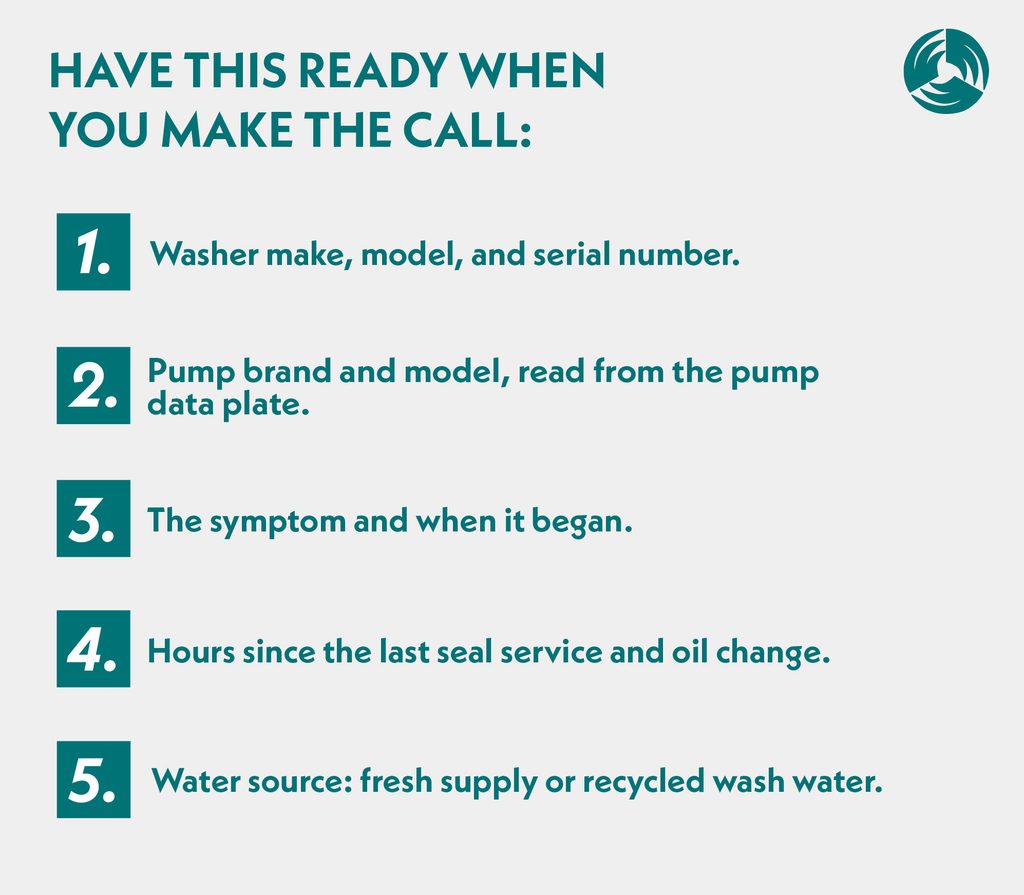
Before You Call: Three Facts to Write Down
Pro tip: Before you call us or any other repair shop, write down the pump model, the symptom, and the date of the last seal and oil service. A technician can do a lot with those three facts.
Common Pressure Washer and Bean Pump Problems
A pump usually tells you what’s wrong before it quits. Each symptom points to a specific wear part, and the Cat Pumps troubleshooting guide for plunger and piston pumps maps them out. Here’s the short version.
| Symptom | Likely cause | Fix |
| Low pressure at the gun | Worn nozzle, which Cat Pumps names as the most frequent cause | Replace the nozzle with the correct size. Leave the regulator alone: cranking it up to compensate will over-pressurize the pump. |
| Pressure falls, then the pump runs starved | Clogged or undersized inlet filter | Clean the filter and check the supply tank for debris. |
| Pulsation | Restricted inlet, air drawn into the line, or worn high-pressure seals | Seal the inlet connections and service the seals. Keep running on worn seals and you can erode the manifold. |
| Loud knocking | Cavitation from an inlet restriction or air leak | Walk the inlet side: filter, check valves, hose clamps, fittings. |
| Sudden loss of pressure | Unloader stuck open from a dirty or worn stem and piston | Pull the unloader apart, clean it, and replace what’s worn. |
| Engine bogs or stalls when you release the trigger | Unloader check valve stuck or worn | Install a check valve repair kit. |
| Water leaking between manifold and crankcase | Worn seals or packings | Install a seal kit at the first sign of low pressure. |
| Milky, foamy, or white crankcase oil | Water in the oil, from condensation or fluid passing worn seals | Shut it down. Find the source, drain the crankcase, clean the drive end, refill. |
Why You Shouldn’t Run Through a Pressure Drop
Don’t run through a pressure drop. Low pressure can be the first sign of worn high-pressure seals. Keep it running, and water works back along the plunger rods toward the crankcase, where it can score the plungers and contaminate the oil. A seal kit at the first drop costs far less than that.
Six conditions speed up seal and valve wear: abrasives in the liquid, excessive heat, cavitation, starvation, harsh chemicals, and hard water. The same guide says to clean inlet filters more often when the liquid is recycled or dirty. If your washer feeds from a closed-loop wash system, move that filter check up your list.
How Humidity Puts Water in Your Pump Oil
Humidity matters here too. Humid air condensing inside the crankcase can be a cause of water in the oil. The fix is to keep the pump out of direct spray, use a ventilated enclosure if it runs in wet conditions, and check the sight glass for milky oil.
Bean pumps are reciprocating pumps too. They take on the heavy work, like tank cleaning, barge flushing, hydro-excavation, and pipe cleaning, and they wear in the same places. FMC/John Bean kits typically come as separate packing kits and valve kits by pump model.
Repair and Maintenance Options
You have two ways to work with us: call when something breaks, or put the machine on a schedule, so it’s less likely to break down. Both run through our Service & Maintenance program.
Repairs with Evans
We handle local pressure washer service and repair at our maintenance branches. If it’s urgent, call. Our technical support team answers 24/7. Call at 2 AM if that is when equipment goes down. We’ll troubleshoot over the phone or dispatch a technician to your site. You’ll get a quote before we touch anything, whether it’s equipment we built and installed or other equipment on your site. Drop it off at a branch, or we’ll come to you.
Scheduled Maintenance Program
A technician works through a checklist built for your system: pumps, motors, belts, valves, and control panels, plus filters and strainers. Plan on at least 2 hours for a pressure washer and wash bay. You end the visit with photos and a maintenance sheet on file, ready for the next audit.
Rental Units
We service rental equipment under the terms of your agreement. Just like when you rent a car, daily and weekly upkeep is your responsibility during a rental. If your own machine is down and the job can’t wait, rent one while it’s in the shop. The rental lineup runs from 3,000 to 5,000 PSI hot water units to a 23 GPM Bean pump system, with techs on call while you run it.
Finding Pressure Washer Parts and Rebuild Kits
Order by pump model. Kits are built for specific pumps, so the data plate on the pump often matters more than the logo on the frame. One valve kit could be listed on six pump models. “Rebuild kit” can mean a seal kit, a valve kit, or both.
Before you pay for a kit, ask which of those parts are in the box. Some suppliers sell plungers apart from the seal kit and direct owners to replace a scored plunger along with the seals.
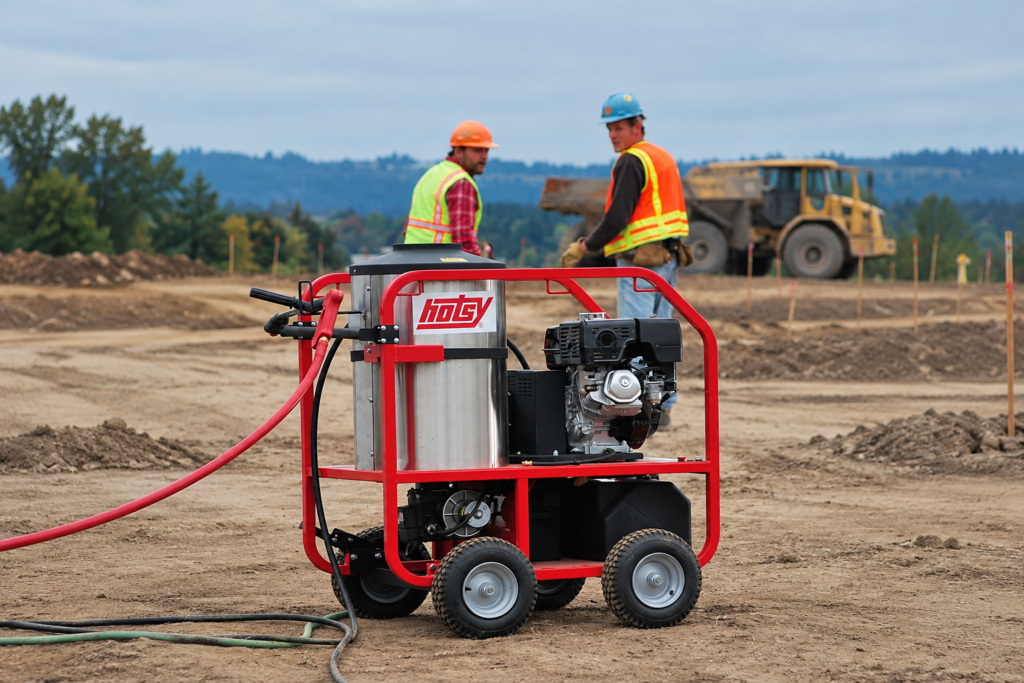
Need parts in south Louisiana or the Houston area? Start with your nearest Evans branch. Our Baton Rouge, Lafayette, and Houston teams support parts, accessories, and chemicals. We sell Hotsy and HyproTek pressure washers.
Find a Repair Branch Near You
Call a branch, and you’ll reach real people who live and work on the Gulf Coast. Find yours below.
| Branch | Address | Hours (Mon to Fri) | Phone |
| Baton Rouge | 8846 South Choctaw, Baton Rouge, LA 70815 | 8 AM to 5 PM | (337) 837-3015 |
| Houston | 205 North 11th St, La Porte, TX 77571 | 7 AM to 4 PM | (713) 451-1162 |
| Lafayette | 233 Tubing Road, Broussard, LA 70518 | 8 AM to 5 PM | (337) 837-3015 |
In the Houston area, we work out of La Porte, and that branch has a dedicated service coordinator for industrial and commercial pressure washer repair calls. We also run service centers for New Orleans and Corpus Christi.
Somewhere else? Call the main line at (800) 377-5872. We support projects across the United States through our regional teams.
Frequently Asked Questions about Pressure Washers and More
It depends on the diagnosis and the parts. Start with a call: our technical support team is available 24/7 and will walk you through the issue by phone. From there, here’s how we handle it: small fixes found during a service visit get quoted and usually handled on the spot. Bigger repairs get quoted first, then scheduled as soon as possible. Emergencies get a technician on the way, right away. Once we know the fault, ask your branch for a time estimate.
We sell Hotsy and HyproTek pressure washers and support parts and accessories at our branches. Running something else? Call with the pump model and part number, and the branch will confirm availability before you make the drive.
Yes. Our Service & Maintenance program supports the equipment we build and install and the equipment we don’t. Bring it to a branch for drop-off repair or ask for on-site service. Have the pump model ready when you call.