
STAY CONNECTED
Signup for our blog to receive tips and knowledge on industrial wash and wash water treatment best practices.
Work with Us
Don’t settle for less than a solution from a partner who takes complete responsibility from start to finish. We make it easy to keep things clean and compliance effortless. Contact us today to discuss your wash water treatment and industrial wash needs.
11/11/2026
Commercial Pressure Washers for Oilfield Services and Refinery Work
Every gallon a pressure washer sprays on oilfield equipment leaves carrying drilling mud, oil, and grease. Where that water goes next determines whether you’re compliant.
The Clean Water Act bars discharging pollutants to U.S. waters without a permit. EPA Region 6, which covers Louisiana and Texas, names washing into a storm sewer or a street that drains to one as the most common pressure-wash violation. The same guidance requires a separate NPDES permit for each discharge location. For crews that change sites every few weeks, that permit burden makes legal discharge impractical.
Region 6 also identifies the most common compliance route: keep wash water from reaching U.S. waters at all. Capture it, recycle it on-site, and the discharge question disappears. Evans builds and rents the equipment for that loop. This guide matches it to four kinds of work.
Support Yards: What a Closed-Loop Wash Bay Fixes
An industrial services company backing Gulf South oil and gas operations was losing money on dirty water in two ways. Hauling it off-site raised costs and environmental liability. Drilling mud clogged its pits and overwhelmed containment, shutting the wash down again and again.
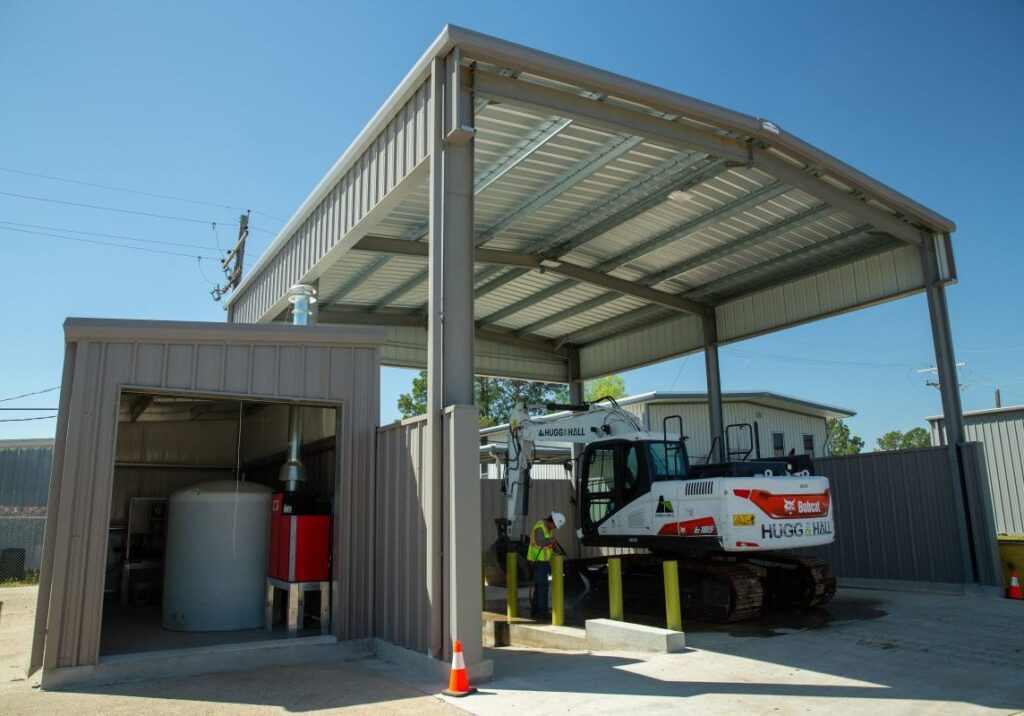
Evans replaced the setup with a permanent drive-through bay and a closed-loop system built for heavy hydrocarbon loads. Multi-stage pits settle the mud. An above-ground separator captures the oil. Mechanical filtration and biological treatment finish the water and send it back to the pressure washers. Evans reports the yard now washes on-site with minimal downtime and significantly lower water and disposal costs.
While Evans can customize every bay, the typical permanent configuration is shown below:
| Component | Typical spec |
| Overall footprint | 35 ft x 65 ft |
| Wash area | 35 ft x 44 ft |
| Settlement pit | 5 ft deep, three compartments |
| Biosystem | Three 600-gallon reactor tanks with aeration and coagulation |
For large equipment carrying heavy solids, Evans recommends a slope drive-in pit, where gravity pulls debris into a recessed collection point before treatment. A correctly sized and maintained system can reuse its water for eight to twelve months between cleanouts.
Commercial Pressure Washers for Oilfield Services
Cold water strips dirt. Grease, oil, and baked-on buildup call for heat. Evans’ diesel hot-water units reach up to 250°F at 3,000 to 5,000 PSI and 3 to 6 GPM, with oilfield tanks, rigs, and frac equipment among their applications.
Commercial Pressure Washers for Petrochemical Services and Refineries
Inside a refinery fence line, the site’s permit already caps what leaves. EPA’s Petroleum Refining Effluent Guidelines govern wastewater at more than 140 U.S. refineries, including a petrochemical subcategory, and take effect through each facility’s NPDES permit. Covered streams include process wastewater and contaminated stormwater. Wash water that escapes a pad can feed one of those capped streams, so containment needs to be in place before the first truck rolls in.
The dirtiest cleaning work sits inside the regulated process. EPA lists tank bottoms, the sediment and water periodically pulled from crude storage tanks, as a refinery wastewater stream. Evans rents to refineries and drilling rigs and delivers portable wash pads and closed-loop treatment anywhere nationwide.
Contamination load decides the equipment. See below:
| Load | Evans unit | Rated output |
| Grease, oil, baked-on buildup | Diesel hot-water pressure washer | 3,000 to 5,000 PSI, 3 to 6 GPM, up to 250°F |
| Tank-farm sludge, heavy oil and gas washdowns | Bean pump system | Up to 3,000 PSI, up to 23 GPM, 300 ft hose |
| Wash water from either | Portable pad or permanent bay with closed-loop treatment | Collects, filters, and recycles water |
Barge Cleaning and Tank Cleaning
Barges and tanks ask for more water than a standard pressure washer can deliver, so Evans uses a bean pump as its barge washer. It pushes up to 23 GPM through 300 ft of hose, roughly four to eight times the flow of a 3 to 6 GPM hot-water unit. Evans names tank cleaning and barge flushing as core bean pump jobs, and its rental package delivers 3,000 PSI at 23 GPM from a tandem-axle trailer, with sewer nozzles and your choice of adjustable spray guns or long lances.
Evans stocks bean pumps built by Giant and powered by Kubota engines. You can rent one, run it on your own site, and then buy once you’re confident it fits the work.
If you clean barges commercially, you may also fall under EPA’s Transportation Equipment Cleaning guidelines, 40 CFR Part 442. This sets limits for facilities that clean the interiors of tank barges and tankers hauling chemical and petroleum cargoes. The rule exempts facilities that discharge less than 100,000 gallons of TEC process wastewater a year, along with those that clean tank interiors only for repair and maintenance (40 CFR 442.1). Recycling on-site lowers the discharge volume that threshold measures, but check your status with your permit writer.
Hydro-Excavation, Pipe Cleaning, and Trench Work
The same bean pump also digs and flushes. With hydro-excavation, pipe cleaning, and trench digging among its uses, Evans also uses them for utilities drain clean-out and heavy sludge. Pipe cleaning creates its own wastewater, so we’ve built around that problem. For one offshore pipe cleaning operation, Evans poured underground pits to settle solids and pre-treat the water, installed a closed-loop system to filter and recycle it, and set up a maintenance plan to keep it running.
If your crews move from site to site, then your containment can move with them. Evans rents modular portable wash pads for temporary and remote jobs and delivers them with closed-loop treatment nationwide.
Talk to an Evans Rep About Your Site
Evans sizes each system to your equipment, daily wash volume, contaminant profile, site conditions, and regulatory environment. Custom builds can go from design approval to operational in 30 to 60 days. Ultimately, our wash bays allow your operation to decrease liability and increase uptime.
Bring your equipment list, wash frequency, and what comes off your trucks and tanks. Book a site evaluation or call 1-800-377-5872.
Frequently Asked Questions
You’ll need a contained pad or bay, a way to settle out solids, oil/water separation, and treatment that recycles the water. Evans’ Gulf South build combined a drive-through bay, multi-stage settlement pits, an above-ground separator, and closed-loop mechanical and biological treatment. Diesel hot-water pressure washers rated 3,000 to 5,000 PSI and up to 250°F handle the cleaning
Yes. Tank cleaning and barge flushing are primary uses, and the rental package delivers 3,000 PSI at 23 GPM with sewer nozzle and long lance options.
Under the Clean Water Act, you need an NPDES permit if your wash water reaches U.S. waters, which includes water that flows into a storm drain. If it never reaches those waters, the Act doesn’t impose requirements. A closed-loop system keeps the water on your site. State and local rules can add their own requirements, so it’s worth confirming with your regulator.