
STAY CONNECTED
Signup for our blog to receive tips and knowledge on industrial wash and wash water treatment best practices.
Work with Us
Don’t settle for less than a solution from a partner who takes complete responsibility from start to finish. We make it easy to keep things clean and compliance effortless. Contact us today to discuss your wash water treatment and industrial wash needs.
01/27/2026
Closed Loop Wash Water Recycling System
Any business having to manage wash water produced by an equipment wash rack knows the challenge of remaining both effective and environmentally compliant with regard to water treatment. Evans has you covered for all your wash water recycling system needs.
Wash Water Disposal
Water consumption and wash water disposal costs really add up. If you find your water retention system building up sludge, it piles on additional expenses for clean-out and possible compliance issues.
Depending upon your location and available waste disposal service options, paying to pump out a wash water retention reservoir can be extremely expensive.
The cost of paying to extract, transport, and dispose of wash water is only outweighed by the danger and cost of a recordable event by contaminating the environment due to an improperly operated or designed water containment system.
The costs and risks associated with single-pass water treatment systems have made them fewer in number than they once were and have paved the way for closed loop water treatment.
Closed Loop Water Treatment Basics
Closed loop water treatment systems for equipment wash racks are becoming increasingly popular among businesses. The systems provide an efficient, cost-effective, and environmentally friendly solution for managing wash water.
These wash rack wash water treatment systems work by recirculating the water used while washing equipment, filtering out contaminants, and reusing the treated water.
Closed loop systems consist of several components, including a holding tank, filtration system, pumps, and controls. There are various technologies that can be applied to best clean the specific wash water being processed.
Mechanical filtration, chemical treatment, and bio-treatment solutions can be applied individually or in combination to properly treat the water.
The concentrations and particle sizes of dirt, grease, oil or other chemicals all contribute to determining which solutions to apply in treating water for re-use.
One of the main benefits of using a closed-loop water treatment system is that it reduces the amount of water waste generated from equipment washing activities. By using a system that deals with wash water filtration for wash rack equipment, you significantly lower water consumption and water costs. Recycling wash water also greatly reduces environmental impact.
Additionally, closed-loop wash systems can help prevent contamination of the area surrounding the wash station, further protecting the environment.
Closed-loop water treatment systems maximize flexibility. A closed-loop system can be customized to meet the specific needs of different applications, such as different wash rack volumes or types of contaminants being removed.
While there are many benefits to using a closed loop water treatment system for equipment washing, it is important to note that proper maintenance and upkeep are essential for ensuring that the system operates properly over time.
Routine inspections and consumable parts replacements such as filters are necessary to optimize system performance and maximize the life cycle of the equipment.
Closed loop water treatment systems offer an effective and efficient solution for managing wash water generated by pressure-washing equipment. These systems provide cost savings, benefits for your environmental compliance, and operational flexibility.
A properly designed and maintained water treatment system provides long-term benefits for your business while protecting the environment.
Closed Loop Wash Water Recycling System
The fundamentals of a closed loop water treatment system are fairly easy to understand but system design and installation are critical to an effective system.
While each individual component of a closed loop water treatment system is simple, properly integrating the components and matching them to the overall application requires some expertise and experience. Like any system utilizing numerous technologies, system reliability relies heavily upon good system design.
A deep dive into system design is beyond the scope of this post, but it is important you have a basic understanding of the variables that can affect your system performance if the builder does not plan for them.
Some of the key elements that the designer has to consider while specifying and matching system components include: wash water volume, wash water pressure, wash water temperature, any solids content including type of solids and particle size in wash water, detergents or cleaning agents, hydrocarbon contaminants, chemical contaminants, utilities available to the wash rack location, wash rack covering options to control external water from other sources such as rainwater.
The message regarding system design is to be sure to have a competent and experienced designer for any wash water treatment system to be assured of a properly operating and reliable closed loop recycling system.
Case Study: Heavy-Duty Crane Wash Bay & Biosystem
The Challenge
A leading industrial crane company needed a high-capacity wash bay and water treatment system for a new facility. They required a closed-loop wash water recycling system capable of handling heavy solids, oils, and hydrocarbons while minimizing downtime and maintaining environmental compliance.
The Solution
Evans Equipment & Environmental delivered a fully turnkey wash bay and closed loop wash water recycling system, designed, built, installed, and serviced by a single team.
The system is centered on a custom slope drive-in pit that captures heavy solids efficiently and directs wash water into an advanced biosystem for treatment and reuse.
System Highlights
- Wash Bay: 35’ x 65’ (35’ x 44’ wash area)
- Pit Design: 5’ deep slope drive-in pit with three settling compartments
- Separation: Above-ground oil and solids separator
- Biosystem:
- Three 600-gallon reactor tanks
- Aeration and coagulation for solid settlement
- Engineered microbes to break down oil, grease, diesel, and drilling mud
The Result
The closed loop system recycles wash water efficiently, reduces disposal costs, and supports ongoing environmental compliance. Now our client can keep equipment clean on-site with minimal operational disruption.
Wash Water Treatment Process
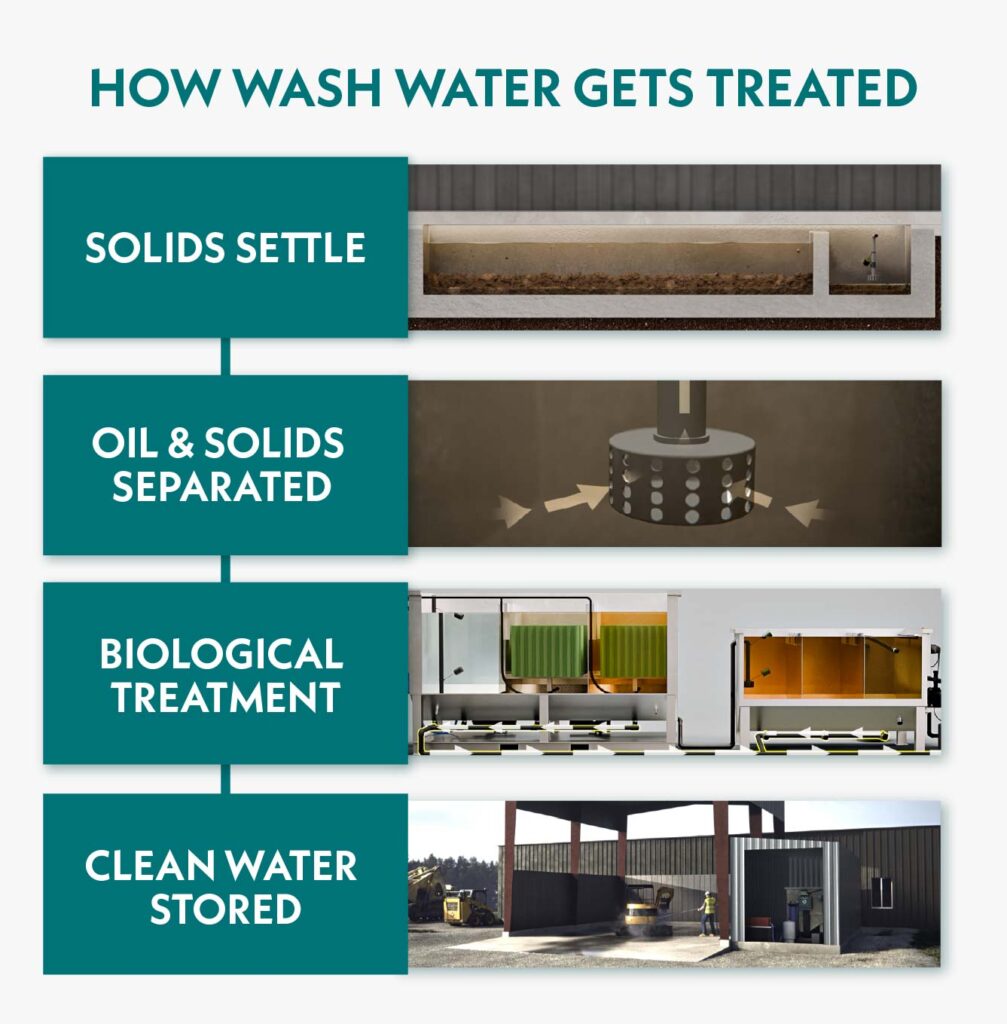
During washing, water and debris enter the initial pit where the heaviest solids settle first. As water progresses through subsequent pits, debris levels decrease. The final pit uses a mechanical float system to pump water into an above-ground separator that captures oils and settles remaining solids.
Water then flows into three 600-gallon reactor tanks where:
- Oxygen supports microbial activity
- Coagulants help suspended solids clump and settle
- Microbes break down oil, grease, diesel, and drilling mud into water and carbon dioxide
Treated water is stored in a 300-gallon tank and can be:
- Recycled back into the wash system
- Discharged through a compliant sewer connection
- Managed through evaporation systems
While discharge requires less maintenance, recycling offers lower long-term cost and reduced liability.
FAQs
A closed loop system captures, treats, and reuses wash water instead of discharging it, reducing water use, financial burden, project management of wastewater disposal, and overall environmental risk.
It eliminates the need for frequent disposal. This closed-loop system allows Evans wash bays to reuse water for months at a time, dramatically reducing freshwater consumption and extending the time between cleanouts as much as eight to twelve months, depending on usage.
Yes. Evans designs systems based on wash volume, contaminants, site conditions, and regulatory requirements. We have popular configurations that can act as starting points for your site, but our in-house design and fabrication team can customize a permanent wash bay to your exact specifications, with optional add ons like spray walls, bollards, and more.
Yes, they are environmentally sustainable options for wash water treatment. When properly designed and maintained, closed loop systems help meet local, state, and federal environmental requirements. Plus, they limit your liability risk.
Yes, our maintenance team offers the final piece of our turnkey solution with monthly, bi-monthly, or quarterly scheduled maintenance programs and 24/7 technical support. All of the work performed is done by Evans-trained technicians who know the gear inside and out.
Yes. The Evans Biosystem is designed to effectively treat water while reducing the ongoing costs of operating a wash bay. With fewer vacuum truck cleanouts, reduced freshwater consumption, lower disposal and compliance costs, and less downtime, the savings add up.